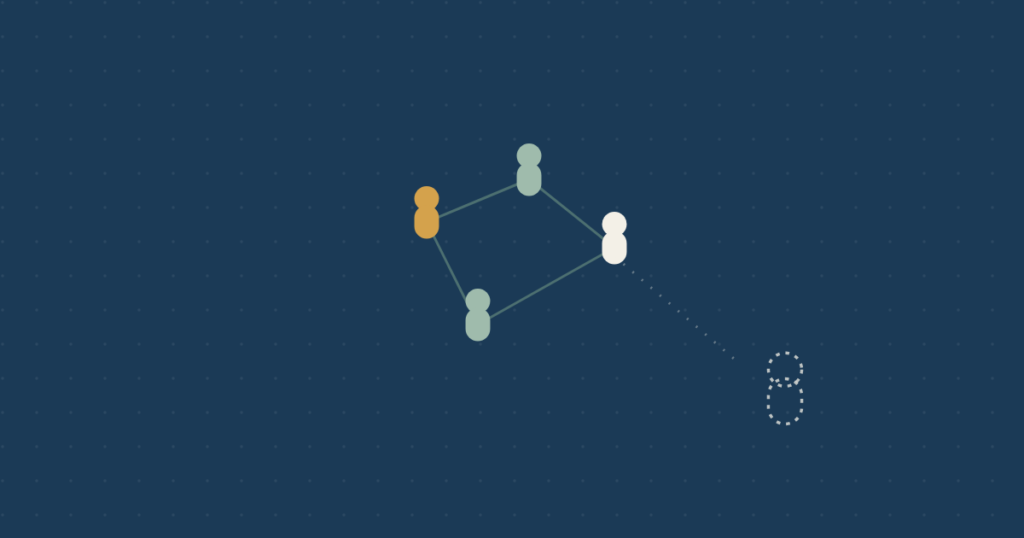
The teams rarely lack honest words; most of their members are carrying them. The problem is that those words stay between two people in the corridor and never reach the room where the team needs them.
Is the problem the individuals or the team’s space?
The CCL white paper on feedback myths reports that participants with highly effective bosses receive feedback daily 8.8% of the time and weekly 45.6%, against 5.1% and 20.5% for those with ineffective bosses, and that participants would prefer more negative feedback than they get (35% against 23%). But these are figures for the one-to-one relationship between a manager and an employee. At the team level the question changes: can an observation made to any member in private be said in front of the whole team without being taken as settling a score? Most teams don’t have that space, so collective feedback turns into what is said after the meeting, not in it.
What happens when the observation is made in front of everyone?
The same CCL paper presents the SBI model (Situation, Behavior, Impact) as a useful tool for anyone giving feedback. In the team’s space it gains a second layer: every other member hears the observation as a signal of “what is allowed to be said here,” not only as an observation for its recipient. That is why the first open corrective feedback in a team’s life is a founding moment. If it is handled with care (a specific behavior, no personalizing, a declared intention) it opens the door to candor; if it is handled with confusion, it closes that door for a long time.
What is the team protecting with its silence?
Kegan and Lahey explain an individual’s resistance to change as a “hidden competing commitment” that arises from deeply rooted “big assumptions.” Chris Argyris defines organizational defensive routines as any actions, policies or procedures designed to prevent the players from experiencing embarrassment or threat and, at the same time, to prevent individuals from discovering the causes of that embarrassment or threat. Reading the team as a whole through the logic of the “hidden commitment” is an extension of Kegan and Lahey’s framework. It is also noted that their book addresses collective immunity as well. The limiting assumption most often found in teams sounds like this: “if we say this openly in front of everyone, we will break something that can’t be repaired.” The paradox is that silence usually costs the team more than the confrontation it is avoiding.
Where does a team begin?
The simplest and safest tool: a fixed few minutes at the end of every regular meeting for one question, “What went unsaid in this meeting that deserved to be said?”, with no pressure on anyone to answer. The consistency of the question, not the quality of the first answers, is what gradually builds the conviction that this space exists and is safe.
A practical takeaway: ask this question in the last five minutes of your next team meeting, and don’t answer it yourself or comment on what is said. Just observe who speaks first, and what they say.
Sources
- Gentry, W. A., & Young, S. F. (2017, April). Busting Myths about Feedback: What Leaders Should Know. Center for Creative Leadership (white paper).
- Kegan, R., & Lahey, L. L. (2001, November). The real reason people won’t change. Harvard Business Review.
- Argyris, C. Organizational Behavior: Production of Knowledge for Action in the World of Practice (Cornell eCommons), which defines organizational defensive routines and points to Overcoming Organizational Defenses (1990).
Next step
If your team avoids candor in its shared meetings, a short team diagnostic — you can book one at saadhamidi.sa — will show where the silence actually lives before it turns into a cost.