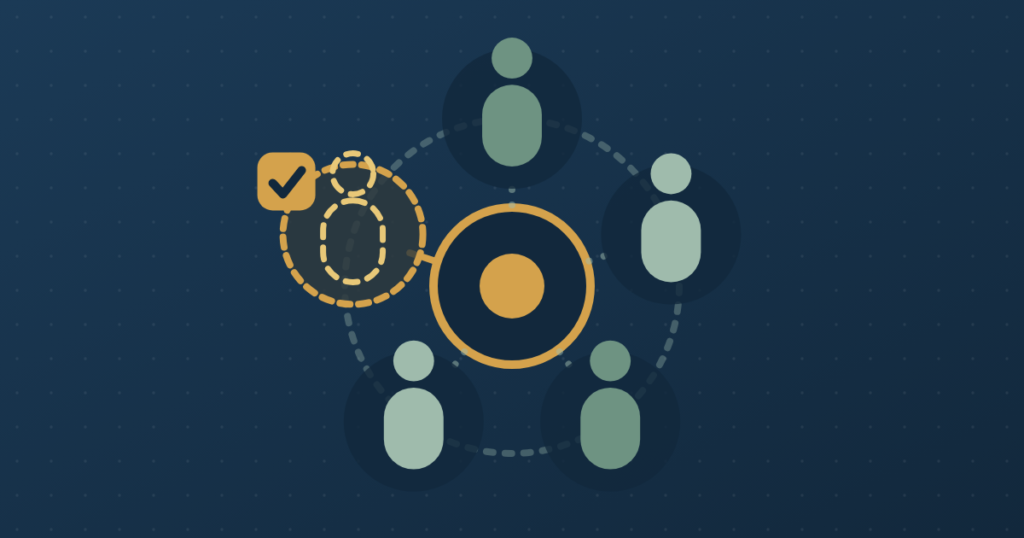
Hogan Assessments published a case study about a health and safety team that a large organization created to address “widespread and systematic safety failures, including worker deaths.” The case study describes the team as heavy on people in the relationships role with none in the results role; the CEO persevered with the same membership for another 12 months, giving stronger and stronger direction, and the team was disbanded in a later restructure. The case study quotes Dave Winsborough, VP of Innovation at Hogan X: “We found that there are five psychological roles to which people naturally gravitate: results, relationships, process, innovation, and pragmatism.” It adds that people are naturally attracted to others who are like themselves, so self-formed teams are likely to be fairly homogeneous, and that when the roles are correctly balanced the natural push and pull between them creates healthy conflict that helps a team function. This is a framework from a commercial personality-assessment firm, so it is treated as a thinking tool, not as settled research.
McPherson, Smith-Lovin and Cook state that “similarity breeds connection” and that this principle structures network ties of every type, including work ties. Homogeneous teams are likely to follow when members choose one another, or when an owner picks people he is comfortable with. A homogeneous team may be comfortable, but it may lose what it cannot see: who objects, who follows through and who asks whether it is doable.
Why does a homogeneous team end up in groupthink?
Irving Janis described a mode of thinking that people engage in when they are deeply involved in a cohesive group, when the members’ strivings for unanimity override their motivation to realistically appraise other courses of action. In small companies, owners are often seen picking managers because they “feel comfortable with them,” a homogeneity criterion par excellence; in that setting disagreement may be read as disloyalty rather than as a critical contribution. It is therefore worth asking the owner: “Who was the last person to disagree with you on an important decision, and what happened to them afterward?” The answer reveals a great deal about the organization’s culture of disagreement.
Is friction always useful?
The research does not support that idea as a blanket claim. The meta-analysis by De Dreu and Weingart found strong negative correlations between task conflict and team performance and member satisfaction, with the negativity stronger in complex tasks, and the damage was lighter when task conflict stayed separate from relationship conflict. So the call here is not for more friction but for a mix of roles that allows disagreement over the idea without turning into disagreement over the people. A harmonious team with no objections is not necessarily sound; an argumentative one is not necessarily stronger.
Which role is most often missing in small teams?
In small companies the scarcest role is often follow-through (close to the “process” role in Hogan’s framework): the person who records what was agreed and follows up on execution. These teams are full of results and idea people, but what is not recorded gets renegotiated, so every meeting starts from zero. No formal instrument is needed to spot the missing role; it is enough to ask: “Who chases the tasks after every meeting?” If the answer is “no one” or “everyone, sometimes,” the role is missing.
According to Hogan’s framework, the other roles can be read from repeated behavior in meetings: the “results” person pushes toward a decision and is impatient with long discussion, the “relationships” person watches others’ emotions and steps in at moments of tension, the “innovation” person interrupts with a new idea before the current one has settled, and the “pragmatism” person asks whether this is really feasible with our resources.
If you watch the first ten minutes of a meeting without intervening and note who pushes toward a decision, who watches the tension, who offers a new idea and who asks whether it is doable, you have a preliminary map before any survey.
When is consensus only for show?
Janis counts the “illusion of unanimity” among the symptoms of groupthink: when people who respect one another’s opinions arrive at a unanimous view, each member is likely to feel that the belief must be true, and this reliance on consensual validation tends to replace individual critical thinking unless there are clear-cut disagreements. In the Bay of Pigs decision the consensus looked complete because some members kept their misgivings to themselves: Janis reports Sorensen’s conclusion that doubts “were entertained but never pressed,” partly out of fear of being labelled “soft” or undaring in the eyes of their colleagues. In a culture that values consultation, the group and the avoidance of embarrassment, everyone may show agreement in the meeting and then each acts independently in execution. That is the illusion of collaboration, not collaboration. The proposal is a clear separation between a consultative meeting, where everyone gives an opinion, and a decisional one, where a single person decides after listening. Announce it at the start of the session: “This session is for consultation, not decision; so-and-so will decide after listening,” then notice what changes in how candid people are. This does not mean an individual decision is always better; everyone should simply know before speaking what their words weigh.
How do we bring a drifting team back to its goal?
Teams drift from their goals gradually, not suddenly: a meeting turns into general complaints, a task becomes a discussion rather than a decision, and a goal blurs until it is rarely mentioned. Redirecting does not need a dramatic intervention; one sentence is enough: “What do we need to say to close this topic today?” together with an explicit time slot for each agenda item, and saying “our time for this item is over, so what is the decision?” without apology.
A practical takeaway: Ask your team two questions: who chases the tasks after every meeting, and who was the last person to disagree with us on an important decision, and what happened to them afterward? The answers tell you about the missing role and about your culture of disagreement more than any survey.
Sources
-
McPherson, M., Smith-Lovin, L. & Cook, J. M. (2001), “Birds of a Feather: Homophily in Social Networks,” Annual Review of Sociology 27, 415–444.
-
Janis, I. L. (1972), Victims of Groupthink: A Psychological Study of Foreign-Policy Decisions and Fiascoes, Houghton Mifflin, Boston.
-
De Dreu, C. K. W. & Weingart, L. R. (2003), “Task versus relationship conflict, team performance, and team member satisfaction: A meta-analysis,” Journal of Applied Psychology 88(4), 741–749, DOI: 10.1037/0021-9010.88.4.741.
-
Hogan Assessments (2016), “Hogan case study: The nice team that went nowhere,” posted December 27, 2016, Hogan Assessments blog, hoganassessments.com
Next step
If your team is harmonious but starts every meeting from zero, or agrees in the room and diverges in execution, a short introductory conversation is enough to open the topic, with no commitment and no sales pressure. Book a session.