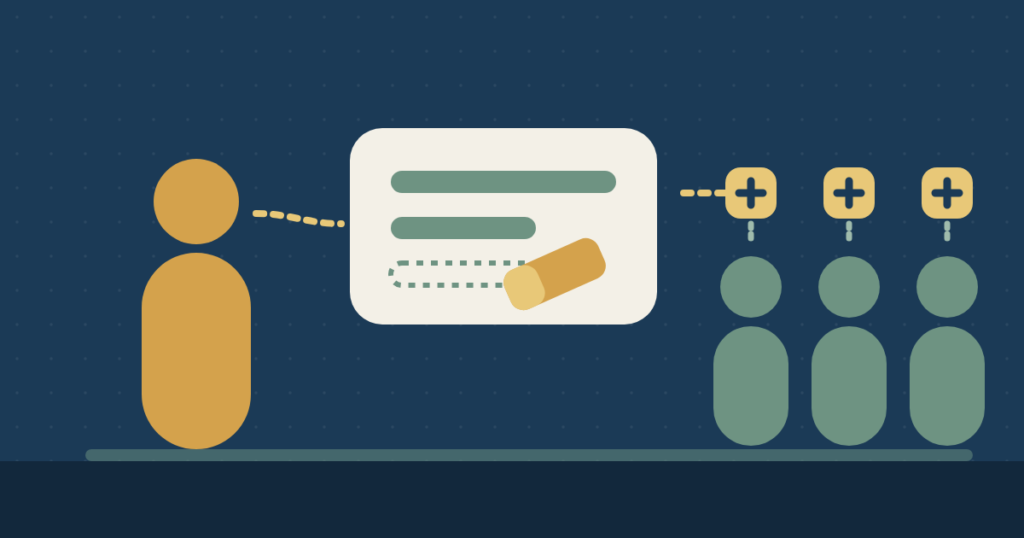
A leader writes a message to a colleague: “Do you have ten minutes to help me with this file?” They read it, delete it, and type instead: “I’ll manage.” That deleted message is the doorway into the fifty-second limiting belief: “asking for help is weakness.”
The usual distinction in this series applies: the event is not the belief. Real events took place: a request for help that was met with “isn’t that your job?”, or a promotion that went to a colleague known as someone who “needs no one,” or an admission of difficulty that was later used in an appraisal meeting. In those environments, asking really was costly. The belief is the silent verdict that stayed after the environment changed: “whoever asks diminishes themselves.” The lesson was about a place and a time; the verdict made it a law carried into every new team.
How does this show up in the team?
In the organisations, three patterns recur.
The late request. The leader asks for help only when things have become urgent, so their requests reach the team as alarms. People learn that “I need you” means “something is on fire,” so they respond in a hurry, and the help arrives incomplete because its moment has passed. The leader concludes that leaning on others is of little use, and so the verdict feeds itself.
The disguised request. They do not say, “Can you help me?” but, “I’ll need this report tomorrow.” The request becomes an assignment so that it does not look like a request. The person assigned has no room to say, “I can’t right now,” so their real load never surfaces, and the work arrives late or incomplete without anyone knowing why.
One-way giving. This leader helps everyone and is never helped. They extend a hand to every colleague who struggles and turn away every hand extended to them. Over time the team may sense that the relationship with its leader has only one pan on the scale: they take from the leader and have nothing to give back. An unwritten rule forms: whoever asks for help here counts for less, so people hide their difficulties until the deadline nears.
What does the research say about the cost of asking?
This fear has been tested experimentally. Alison Wood Brooks, Francesca Gino and Maurice E. Schweitzer found that people hold back from seeking advice for fear of looking incompetent, and that this fear is misplaced: those who seek advice are seen as more competent than those who do not, with the effect depending on the difficulty of the task, on whether the advice is sought from the evaluator personally, and on the advisor’s expertise; someone who consults a non-expert looks less competent. Francis J. Flynn and Vanessa K. B. Lake found that help seekers underestimated the acceptance of their direct requests by about 50%, because they do not appreciate the social cost of refusing for the person asked.
An essential note: this description is a practical framework for reading leadership behaviour in a team, not a clinical classification, and not a substitute for specialist follow-up where needed. Anyone who finds that difficulty in asking for help has become a burden on them or on the people around them to a troubling degree should take specialist support as the appropriate first step, psychological or professional depending on the nature of the impact.
What changes when asking becomes a work tool?
The practical difference worth reflecting on: the aim is not for the leader to ask more often, since self-reliance is a real skill. The problem is when asking is struck from the list of options before it has been considered. The aim is to handle it like any other decision: of whom? for exactly what? by when? with a refusal remaining acceptable. That shape eases on the person asked the weight of refusing that the study points to, and teaches the team that a request with a clear deadline and room to decline is not weakness but a design for shared work. The leader who strikes asking out pays for the incomplete work and for problems surfacing late; the leader who asks clearly shows their team that drawing on others is part of competence.
Practical takeaway: this week, ask one colleague for one specific thing with three elements: exactly what is needed, by when, and that declining is fine; then notice what you told yourself before sending and what happened afterwards.
Sources
- Brooks, A. W., Gino, F., & Schweitzer, M. E. (2015). Smart people ask for (my) advice: Seeking advice boosts perceptions of competence. Management Science, 61(6), 1421–1435.
- Flynn, F. J., & Lake, V. K. B. (2008). If you need help, just ask: Underestimating compliance with direct requests for help. Journal of Personality and Social Psychology, 95(1), 128–143.
If you recognise one of these patterns in your team more than once, a short team-diagnostic conversation (book one at saadhamidi.sa), adapted to your team and your context, is a suitable first space to see where help is asked for and where it is withheld, and nothing more than that at this stage, with no commitment.