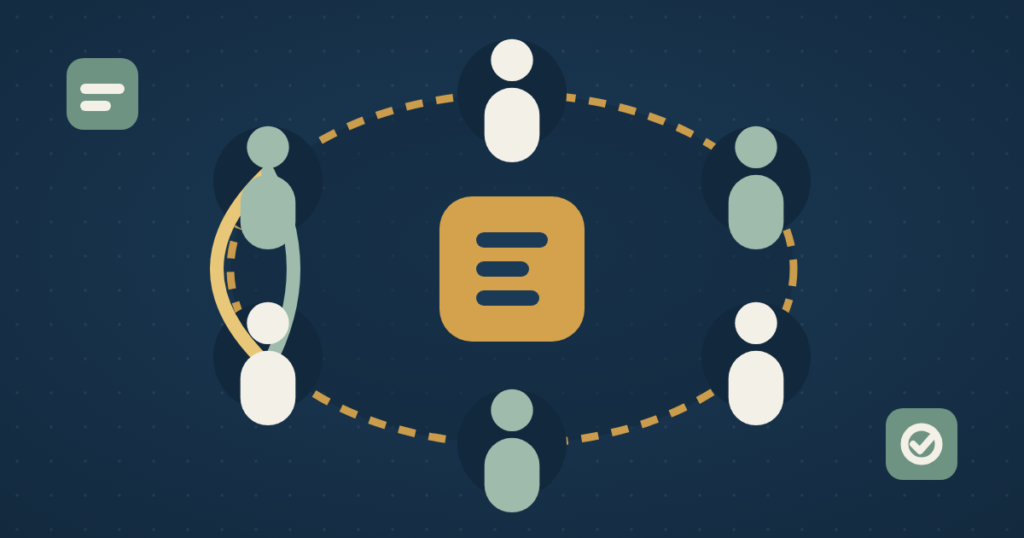
In Behfar, Peterson, Mannix and Trochim’s study, the main source here, the researchers used a qualitative design to examine 57 autonomous teams and learn how ways of managing conflict relate to team performance and members’ satisfaction. The question for anyone leading a team: if each member has their own style in conflict, what makes the team as a whole come out of its disagreements stronger rather than weaker? The answer likely lies in the processes a team agrees on, not in the sum of its members’ styles.
What do teams that sustain their performance have in common?
The study concluded that teams that improved or maintained top performance over time share three tendencies: they focus on the content of interpersonal interactions rather than the delivery style, they explicitly discuss the reasons behind decisions about accepting and distributing work, and they assign work to members with the relevant expertise rather than by volunteering, default or convenience. Its results also suggest that teams that succeed over time are proactive in anticipating the need for conflict resolution and pluralistic in developing resolution strategies that apply to all members. What stands out is that these tendencies are processes a team can agree on and write down, not personal traits a member is born with. That makes them easier for a team leader to start with than trying to change each member’s temperament.
Is disagreement over the task good for a team?
Bradley and colleagues’ study starts from earlier research suggesting that task conflict may improve performance under certain conditions, without specifying them. In their sample of 117 project teams, task conflict was associated with better performance when the team’s psychological safety climate was high, which the authors read as that climate enabling a team to reap the benefits of task conflict. In Simons and Peterson’s study of 70 top management teams, intragroup trust moderated the relationship between task conflict and relationship conflict, and the authors concluded that trust is the key to gaining the benefits of task conflict without suffering the costs of relationship conflict. So the question is not whether a team disagrees a lot or a little; that question reveals nothing about the quality of the disagreement. The better question is whether the team has enough trust and safety to keep a disagreement over an idea a disagreement over the idea.
Does a team have a “conflict culture” beyond its members?
In Gelfand, Leslie, Keller and de Dreu’s study of leaders and members from 92 branches of a large bank, three conflict cultures emerged at the unit level: collaborative, dominating and avoidant, understood as norms that unit members socially share about how conflict should be managed. Leaders’ own conflict-management behaviors were associated with the type of culture in their unit, and those cultures were associated with branch outcomes: viability (cohesion, potency and burnout) and performance (creativity and customer service). This is an association in one sector, not a proven cause, but it suggests that “how we disagree here” is a collective rule a team learns from what it sees its leader do, not the sum of its members’ styles.
How far do these studies go?
These four studies should be read with caution. Behfar and colleagues’ study is qualitative, and the samples of the other studies are project teams, top management teams and bank branches. That is, it describes what successful teams have in common and does not estimate the size of each tendency’s effect, and their contexts may not resemble a given team. So what precedes is best treated as hypotheses to test in the team through small experiments, not ready-made recipes, telling the team it is an experiment, not an imposition.
What can be tried in the team’s next meeting?
These are three small experiments drawn from these studies:
- State openly the reason behind every decision that assigns a task, so everyone knows why that person was chosen and suspicion of favoritism shrinks.
- When things heat up, ask: did the content of what was said bother us, or the way it was said? Then deal with the content first, and leave a discussion of style to a one-to-one conversation if needed.
- Assign the task by declared expertise, not by who volunteers fastest, and ask the team: who is really best placed for this?
It is better to start with only one, and to tell the team it is a two-week experiment, not a permanent rule, because the psychological safety and trust the studies point to are not built by a single decision.
A practical takeaway: In your team’s next meeting, pick one decision that assigns a task, state its reason in front of everyone, and notice whether the amount of open objection changes and whether the objection stays on the idea rather than on its owner.
Sources
- Behfar, K. J., Peterson, R. S., Mannix, E. A. & Trochim, W. M. K. (2008), “The critical role of conflict resolution in teams: A close look at the links between conflict type, conflict management strategies, and team outcomes,” Journal of Applied Psychology 93(1), 170–188.
- Bradley, B. H., Postlethwaite, B. E., Klotz, A. C., Hamdani, M. R. & Brown, K. G. (2012), “Reaping the benefits of task conflict in teams: The critical role of team psychological safety climate,” Journal of Applied Psychology 97(1), 151–158.
- Simons, T. L. & Peterson, R. S. (2000), “Task conflict and relationship conflict in top management teams: The pivotal role of intragroup trust,” Journal of Applied Psychology 85(1), 102–111.
- Gelfand, M. J., Leslie, L. M., Keller, K. & de Dreu, C. (2012), “Conflict cultures in organizations: How leaders shape conflict cultures and their organizational-level consequences,” Journal of Applied Psychology 97(6), 1131–1147.
Next step
If your team argues and heats up, or goes quiet and lets things pile up, a short team-diagnosis conversation — you can book one here — is enough to read how it disagrees and what protects it, with no commitment and no sales pressure.