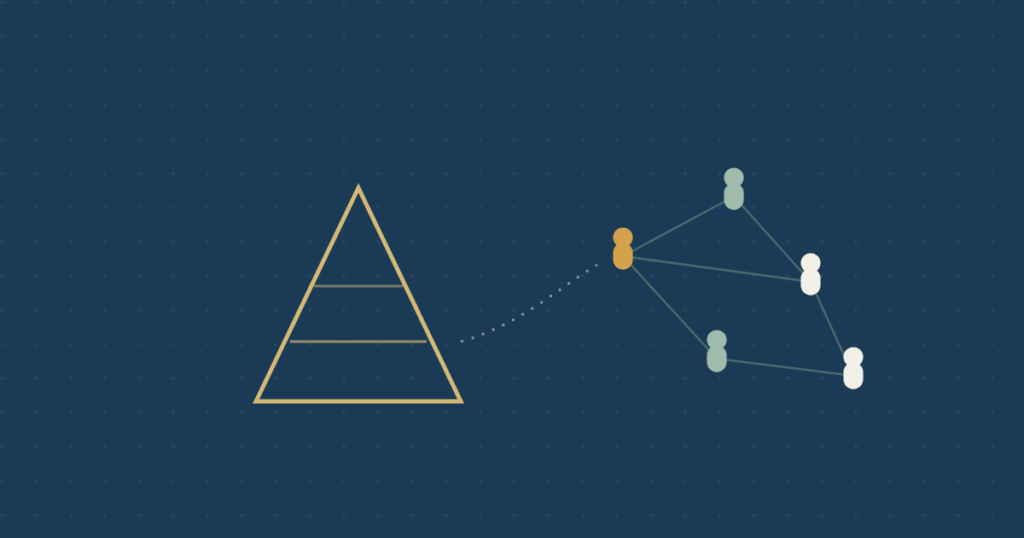
Almost every organization says it wants “more agility” and “decentralized decision-making,” and then pulls back when the discussion reaches the practical question: so who decides?
What does Laloux mean by a Teal organization?
Frederic Laloux describes the evolution of organizational forms through stages he names by color: Red (crude, often violent groups), then Amber (order, control and hierarchy; the invention of formal roles and hierarchies was a major breakthrough), then Orange (the world as a complex mechanism that can be understood and exploited through scientific and empirical investigation, with effectiveness replacing morality as the yardstick for decisions), then Green (cooperation over competition, equality, solidarity and tolerance), then Teal, which operates effectively, even at large scale, with a system based on peer relationships. He presents three breakthroughs: Self-Management, where decision rights and power flow to any individual with the expertise, interest or willingness to step in; Wholeness, inviting people to reclaim their inner wholeness; and Evolutionary Purpose, basing strategies on what people sense the world is asking from them.
Which color is your organization in today?
The practical value of this classification is not in picking the “best color” but in knowing which color your organization actually stands in before designing any intervention. Many organizations encountered in practice are Amber in structure and Orange in language: a rigid pyramid, precisely defined roles, and innovation that is implicitly punished when it touches the existing order. Modernization attempts in them tend to jump into Teal vocabulary (delegation, ownership, agility) on top of a structure that has not built the trust needed to carry it. The result is a distorted hybrid, not a transformation. And an intervention designed for an Orange organization produces, in an Amber one, resistance that is misread as “negative culture” when it is really a natural institutional defense.
What is the real obstacle: will or trust?
In small and medium-sized enterprises in particular, the obstacle is often not will but trust, and it runs in both directions: the owner doesn’t trust the team’s ability to decide, and the team doesn’t trust that its decision will be respected if it contradicts the owner’s view. Breaking this loop doesn’t begin with a workshop on empowerment but with a small, specific experiment: decision authority of one type, given to one team, for a set period, within limits agreed in advance. Its result, whatever it is, teaches more than twenty workshops.
Which practice is closest to applying now?
The simplest practice that moves you toward this pattern without risking the whole system: the decision-maker decides after consulting those who will be affected and those with expertise, so the decision stays in their hands and the advice is heard but its approval is not awaited. It differs radically from a culture of committees and “the boss’s sign-off,” yet it does not abolish accountability but redistributes it, and it can be tried partially at one level. Laloux is credited with naming a close practice the “Advice Process”. Similar experiments in distributing decisions are attributed to Ricardo Semler at Semco and to Gary Hamel and Michele Zanini.
And what about strategic planning?
Laloux writes that none of the organizations he researched has a strategy document, and that they have dropped much of the machinery of midterm plans, yearly budgets and cascaded KPIs; instead of trying to predict and control, they aim to sense and respond. In an environment where targets are declared and binding, this tension remains present: a commitment to the plan, and a reality that changes faster than it does.
A practical takeaway: identify one type of decision whose authority could move to a lower level on condition of prior consultation. Write down the condition and its limits, try it for three months, then evaluate.
Sources
- Laloux, F. (2015). The future of management is teal. strategy+business, Issue 80 (Autumn).
- Laloux, F. (2014). Reinventing Organizations.
- Semler, R. (1993). Maverick.
- Hamel, G. & Zanini, M. (2020). Humanocracy.
Next step
If your organization talks about empowerment while every decision returns to a single point, a short scoping call — you can book one at saadhamidi.sa — will pin down where your organization actually stands before any intervention.