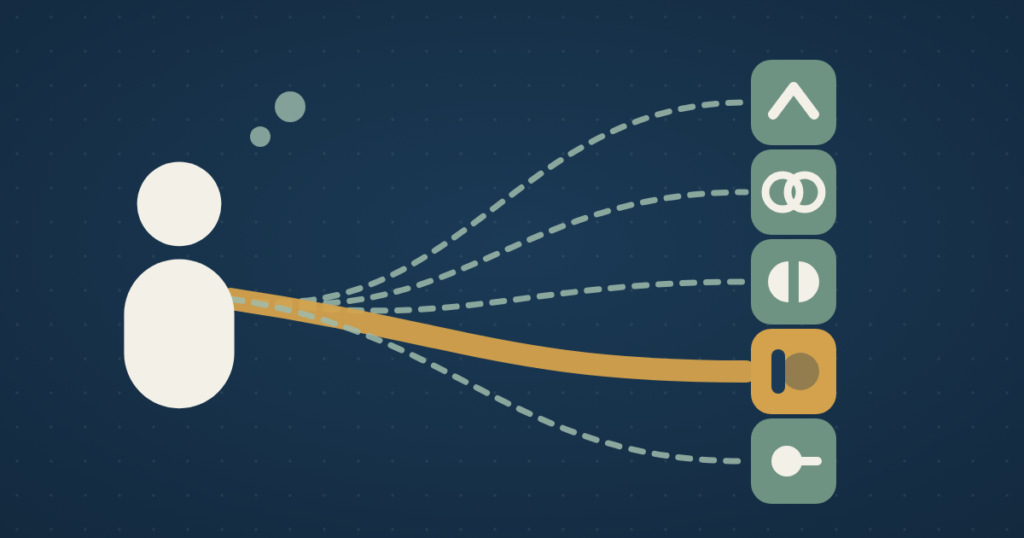
Ralph Kilmann, co-author of the Thomas-Kilmann Conflict Mode Instrument, summarizes what four decades with his own tool taught him. He says the instrument measures the relative frequency with which you use five modes in a conflict: competing, collaborating, compromising, avoiding and accommodating, and that after reading your results you realize that, out of habit, you overuse one or more modes and underuse others. The instrument consists of 30 pairs of statements from each of which the respondent picks the one that better describes their behavior, which takes less than ten minutes. The question for anyone who leads: “When a client rejects my diagnosis or a partner disagrees with me, am I reading the situation or repeating an old reflex?”
What two axes do the five modes rest on?
Kilmann arranges the modes on two axes: assertiveness, the effort to meet your own needs, and cooperativeness, the effort to meet the other party’s needs. Competing is assertive and uncooperative, accommodating is the reverse, avoiding is low on both, compromising sits in the middle, and collaborating aims to meet both parties’ needs. He adds that each mode works under certain conditions: competing suits a topic far more important to you than to the other person, and accommodating suits the opposite. He warns that someone whose profile is topped by competing, accommodating and compromising may see life as a win-lose contest over a fixed pie and miss the wider field that collaborating opens. So no mode is judged in itself. When a flawed financial set-up that a client insists on is refused, competing is professional firmness; when a view is imposed on a topic that matters to both sides more than it matters to the one imposing it, it is domination.
When is avoiding good, and when is it bad?
Kilmann distinguishes good avoiding, withdrawing on purpose to gather information, let emotions cool, or because the matter turns out less important than it seemed, from bad avoiding, withdrawing from a topic that matters to both parties and to the organization out of discomfort with confrontation. He gives two examples of one withdrawal with two different effects: a line like “I’ve had enough of this nonsense and won’t waste any more time” (paraphrased) may hurt those who hear it, while “I’ve realized I need more time to think and I’m feeling overwhelmed, so let’s meet again next week” is easier to accept because the reason is explained. In practice, bad avoiding often disguises itself as “politeness”.
Do others see a leader’s mode the way the leader does?
Kilmann and Thomas report that the conflict measures preceding their instrument were affected by social desirability, so they built theirs on pairs of statements matched for it, and that its scores capture the relative, not absolute, frequency of the modes: a higher score on one mode means a lower score on the others. That is the authors’ own report on their own tool: social desirability accounted for only about 4% of the variance in their sample’s ratings of its items, against more than 80% for the three other instruments, with an average internal consistency of 0.60 and test-retest reliability of 0.64. In De Dreu and colleagues’ study of a different workplace conflict measure, a person’s self-reports, the opponent’s reports and an observer’s ratings converged for problem solving, forcing and yielding, but not for avoiding. Kilmann makes awareness of the result only the first step, followed by sharing it with a small group and hearing how others experience your behavior in conflict, then learning to read the situation, then practicing each mode with respect and dignity. So be most cautious about your own rating of your avoiding, because it is the mode that leaves the least visible trace, and ask someone who watches you before you believe your result.
Which variables should be read before choosing a mode?
Kilmann lists eight variables to learn before choosing a mode: level of stress, complexity of the conflict, its importance to each party, time available, level of trust, quality of speaking and listening, group culture, and importance of the relationship. From experience he roughly estimates that most conflicts are 80% system-driven and 20% people-driven, and reports that Deming put the ratio closer to 85/15. Kilmann recounts that when he modifies the instrument’s instructions to ask how a person responds inside their own organization specifically, he usually finds the average for avoiding in the top quarter, and he explains it by a culture and reward system that penalize people who confront their managers. So before putting a client’s rejection of a diagnosis down to stubbornness, it is worth asking: does their culture or reward system punish admitting the problem?
A practical takeaway: This week, write one sentence about your last professional disagreement in which you gave way or dug in. Name the mode you used and whether you chose it by reading the eight variables or by habit. Then ask someone who sees you disagree: “What is the first thing you notice in how I handle it?” Listen without explaining.
Sources
- Kilmann, R. H. (2011), “Celebrating 40 Years with the TKI Assessment: A Summary of My Favorite Insights,” CPP Author Insights, April 2011.
- Kilmann, R. H. & Thomas, K. W. (1977), “Developing a Forced-Choice Measure of Conflict-Handling Behavior: The ‘Mode’ Instrument,” Educational and Psychological Measurement 37(2), 309–325.
- De Dreu, C. K. W., Evers, A., Beersma, B., Kluwer, E. S. & Nauta, A. (2001), “A theory-based measure of conflict management strategies in the workplace,” Journal of Organizational Behavior 22(6), 645–668.
Next step
If you repeat the same response when a client rejects your diagnosis or a partner disagrees with you, a short introductory conversation — you can book one at saadhamidi.sa — is enough to read the situation together, with no commitment and no sales pressure.